STF · Structural & earthquake engineering
A Novel Kinematic Isolation System for Light-Frame Homes
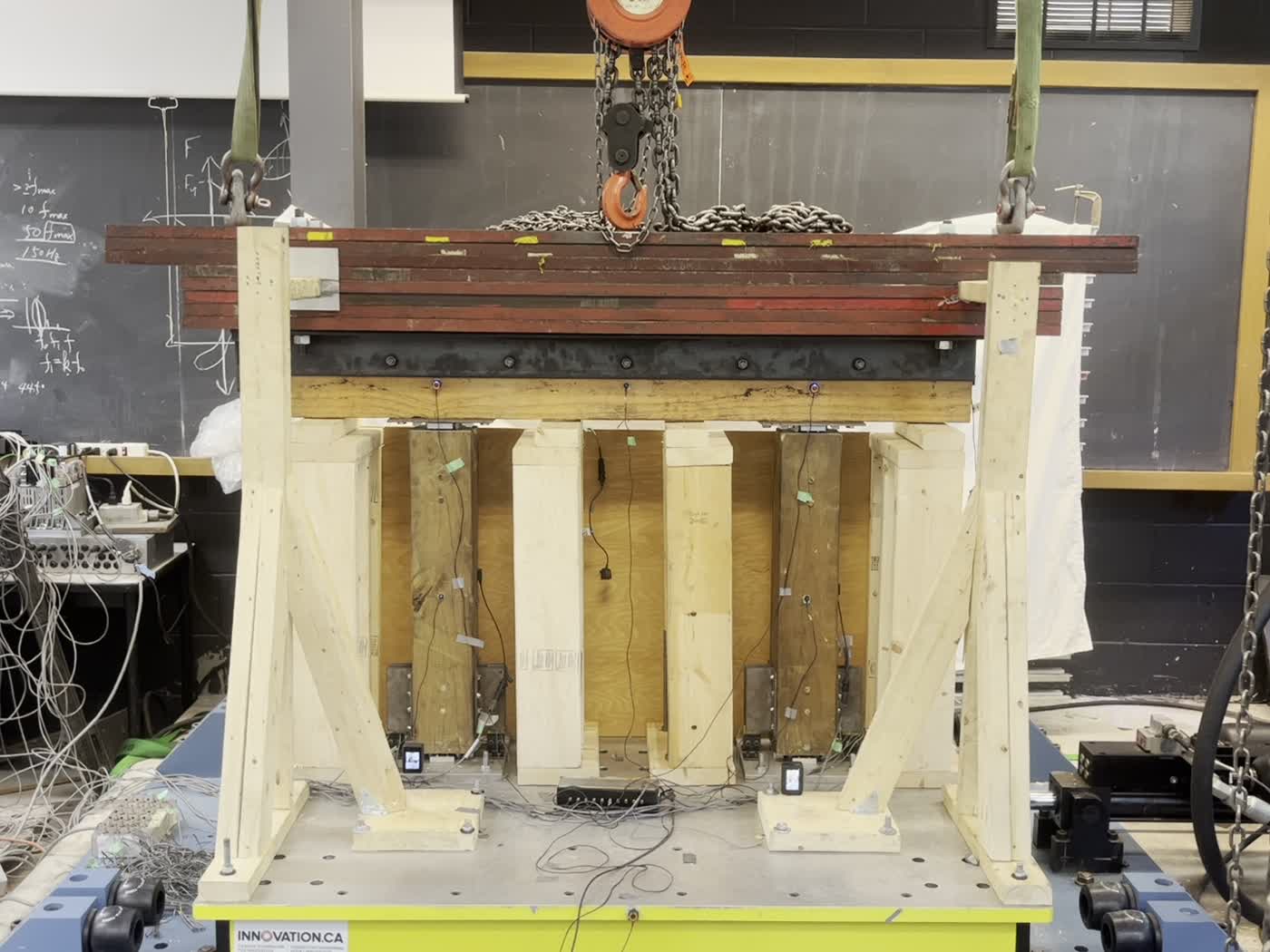
Full-scale rocking isolation tests on a timber-post foundation enhanced with steel plates and viscoelastic dampers.
- Graduate researcher
- Marwan Zaki
- Professor / PI
- Dr. Constantin Christopoulos
- Research area
- Structural & Earthquake Engineering
- Application
- Seismic protection of light-frame homes in Western North America
01Project objective
This research develops and experimentally evaluates a kinematic rocking isolation system for light-frame homes, particularly for earthquake-prone regions such as British Columbia and California. While conventional light-frame homes may avoid complete collapse during earthquakes, they can still experience significant structural damage, displacement, demolition requirements, and costly service interruptions.
The proposed system modifies conventional timber-post foundations using steel plates and viscoelastic dampers, providing seismic isolation without requiring a completely new foundation system. The research aims to make the rocking response more stable, predictable, and practical for engineering design.
02My contribution
As part of my work at the Structural Testing Facilities, I assisted the graduate researcher during the full-scale experimental phase of the project:
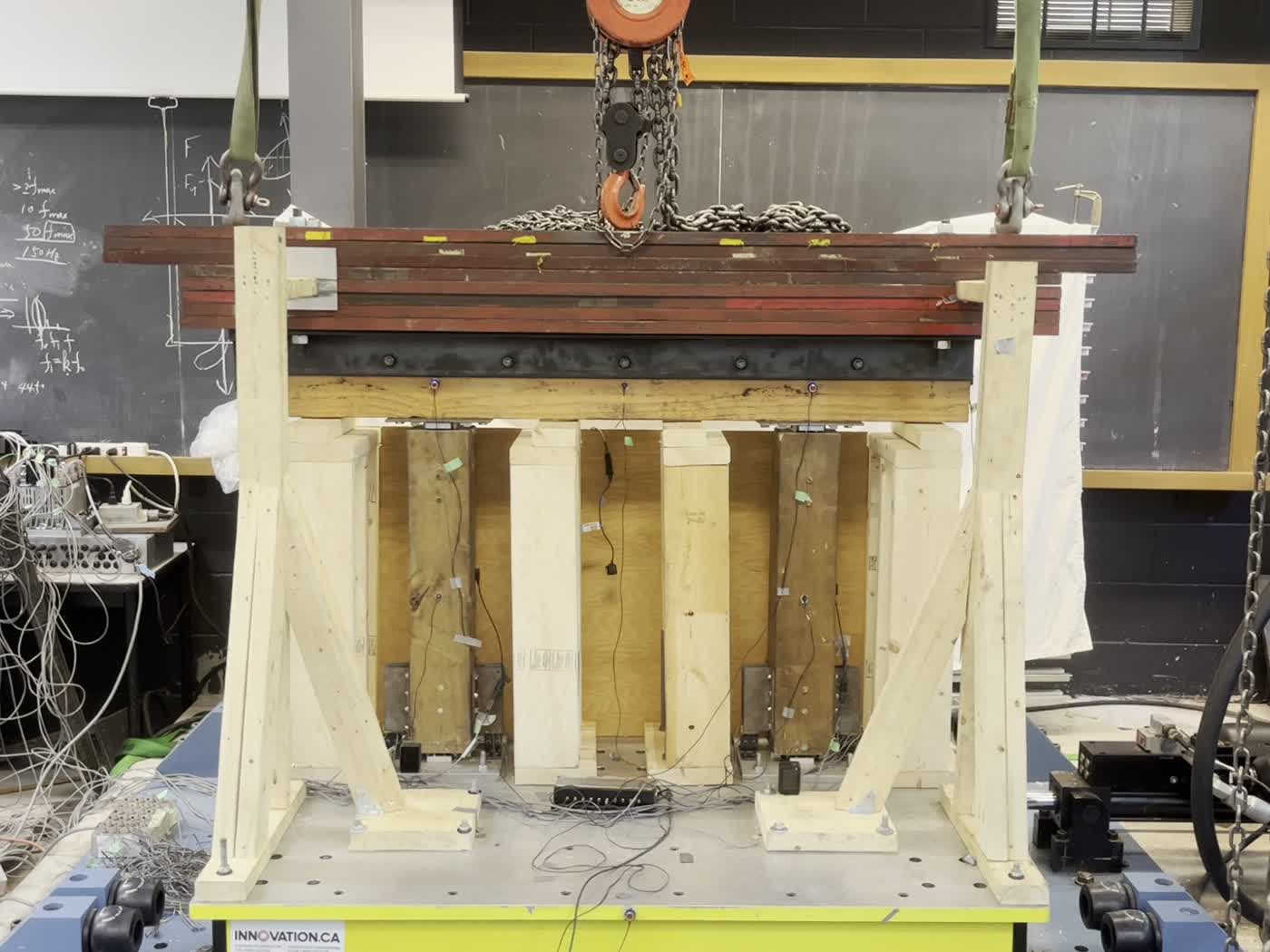
- Supporting preparation and assembly of the timber foundation test setup.
- Assisting with steel plates, timber columns, viscoelastic dampers and associated structural components.
- Supporting preparation and operation of the experimental setup during cyclic and seismic testing.
- Assisting with instrumentation and sensor-related setup.
- Supporting testing activities involving hydraulic loading equipment.
- Observing and assisting with the evaluation of displacement, acceleration, strain and structural response.
03Structural system
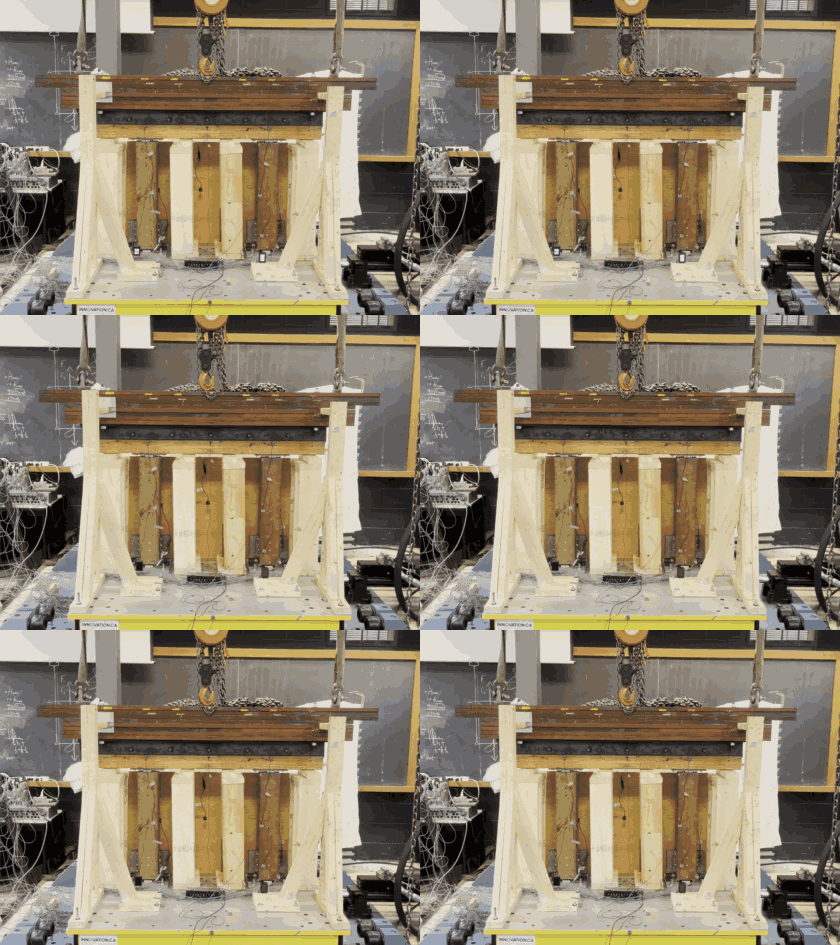
The full-scale experimental setup represents a subsection of a typical timber-post foundation. 6×6 timber columns, steel plates, and viscoelastic dampers are configured to reproduce the rocking behaviour of the foundation during seismic excitation. The dampers serve three functions:
- Increase the stiffness of the rocking system.
- Dissipate kinetic input energy as heat during repeated motion.
- Improve the predictability and repeatability of the structural response.
This allows the foundation to undergo controlled rocking while reducing the seismic demand transferred to the structure above.
04Experimental testing and data collection
The system was subjected to cyclic and simulated seismic loading to evaluate its response under repeated ground motions, comparing the enhanced system against the original unenhanced rocking configuration. Structural response was monitored through:
- Compression-tension load cells for applied forces.
- Uniaxial accelerometers measuring X, Y and Z acceleration.
- Optical LED targets and camera tracking for three-dimensional displacement.
- Strain gauges for monitoring strain and identifying yielding behaviour.
- Hydraulic loading equipment for reproducing dynamic structural motion.
Optical displacement measurements were post-processed using coordinate transformations to determine the relative X, Y and Z movement of the test frame and loading table.
05Results and engineering significance
Testing showed that incorporating viscoelastic dampers produced greater stability and lower displacement compared with the unenhanced rocking system. The enhanced system also demonstrated substantially improved repeatability: repeated applications of the same ground motion produced similar displacement histories, addressing the sensitivity and unpredictability associated with conventional rocking systems.
The project combines analytical modelling, numerical analysis and full-scale experimentation, with the broader objective of developing design recommendations that could support implementation of the isolation system in Canadian building practice.