STF · Reinforced concrete
Shear Properties of Low-Carbon Concrete
Fabricating reinforced panels to test whether existing shear models hold for concrete with up to 50% slag replacement.
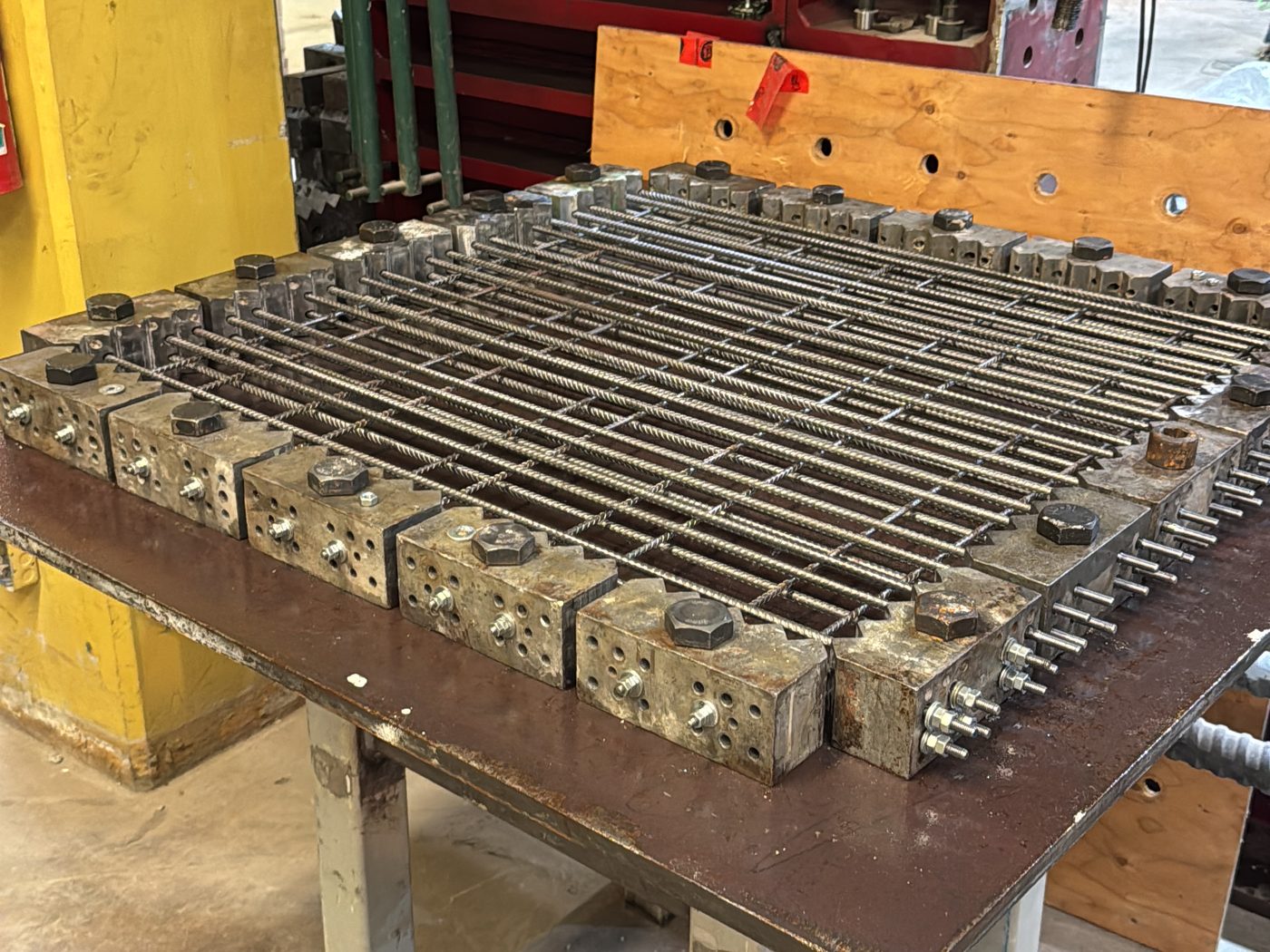
- Graduate researcher
- Awale Omar
- Professors / PIs
- Dr. Evan Bentz & Dr. Daman Panesar
- Research area
- Reinforced concrete & sustainable construction
- Application
- Structural design of low-carbon concrete for buildings and bridges
01Project objective
This research investigates the shear behaviour of low-carbon reinforced concrete containing steel slag as a partial cement replacement. The objective is to determine whether existing shear prediction methods, developed and validated for conventional concrete, can reliably predict the strength, strain response, cracking and creep behaviour of low-carbon concrete.
The research addresses an important barrier to adopting lower-carbon materials: engineers and contractors need confidence that alternative mixtures provide predictable structural performance. The study includes concrete with up to approximately 50% slag replacement.
02My contribution
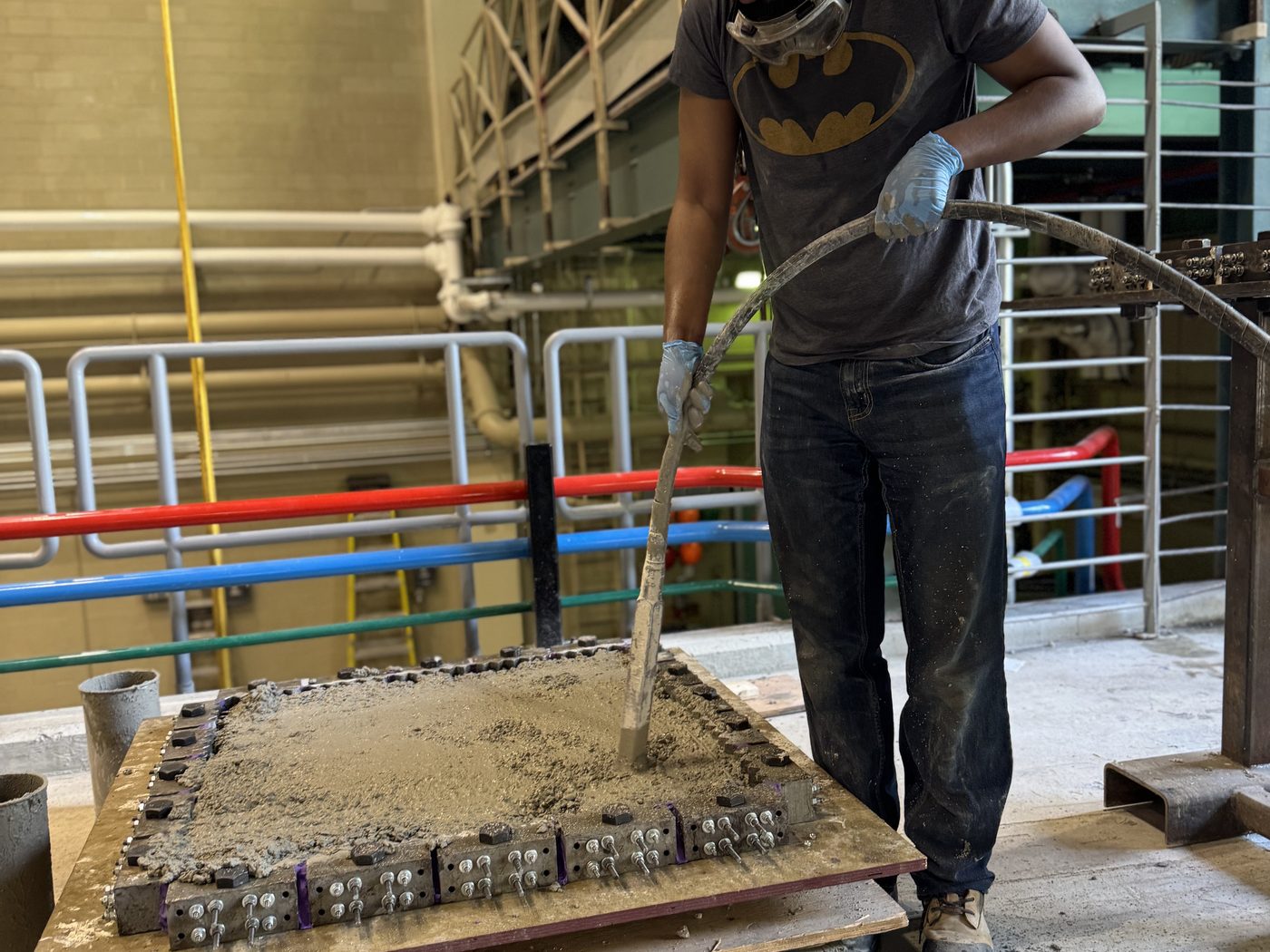
I worked directly with the graduate researcher during the fabrication of four of the seven reinforced concrete test panels:
- Assisted with preparation and assembly of four reinforced panel specimens for experimental testing.
- Worked with reinforcement layouts containing different steel ratios and configurations.
- Assisted with installation and preparation of rebar, threaded rods and perimeter steel blocks required for the Panel Tester.
- Supported concrete specimen preparation and casting activities.
- Gained hands-on exposure to the preparation requirements for controlled structural shear testing.
03Structural system
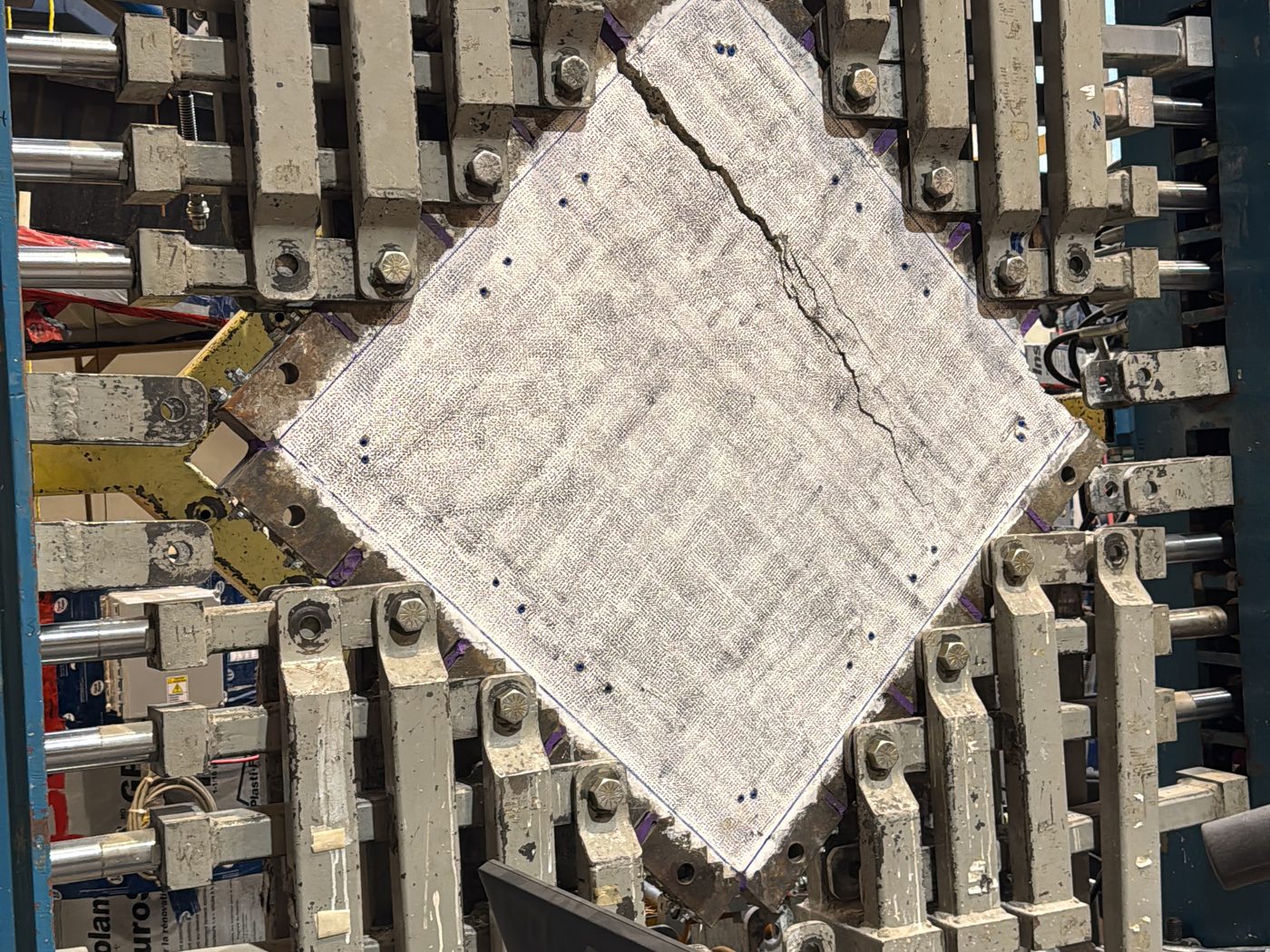
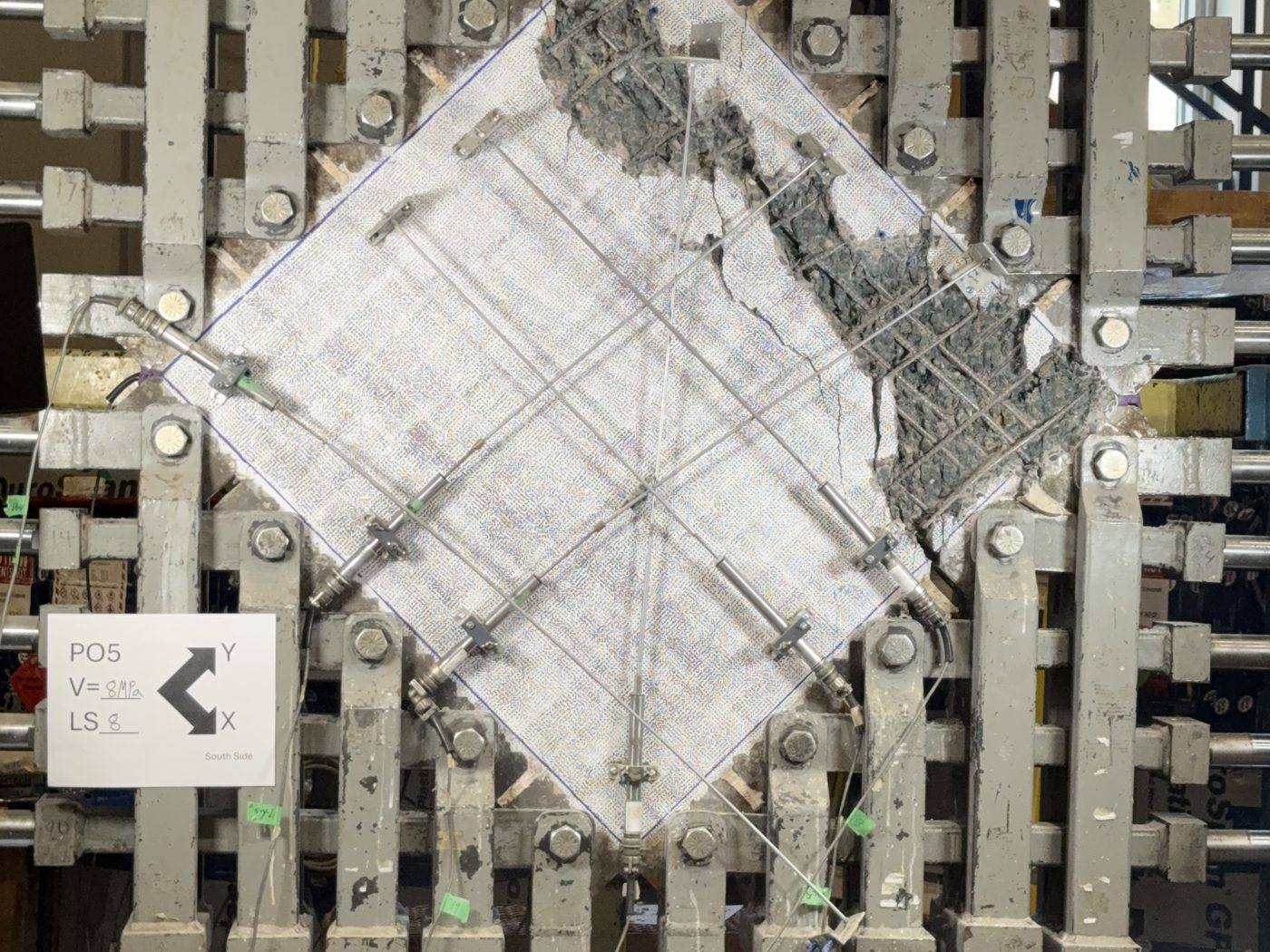
The research uses the University of Toronto's specialised Panel Tester to subject reinforced concrete panels to a controlled state of shear. The experimental program consists of seven 890 × 890 × 70 mm panels with different reinforcement ratios: one orthogonal direction maintains approximately 3.5% reinforcement, while the other varies from roughly 0 to 2.8%. This promotes yielding and cracking primarily in one direction so the shear response can be studied more clearly.
Additional threaded rods reinforce the perimeter to prevent premature edge failure and encourage the critical behaviour to occur within the central test region.
04Testing and data collection
Experimental results are compared against analytical predictions calibrated from previous conventional-concrete panel tests. Key parameters include:
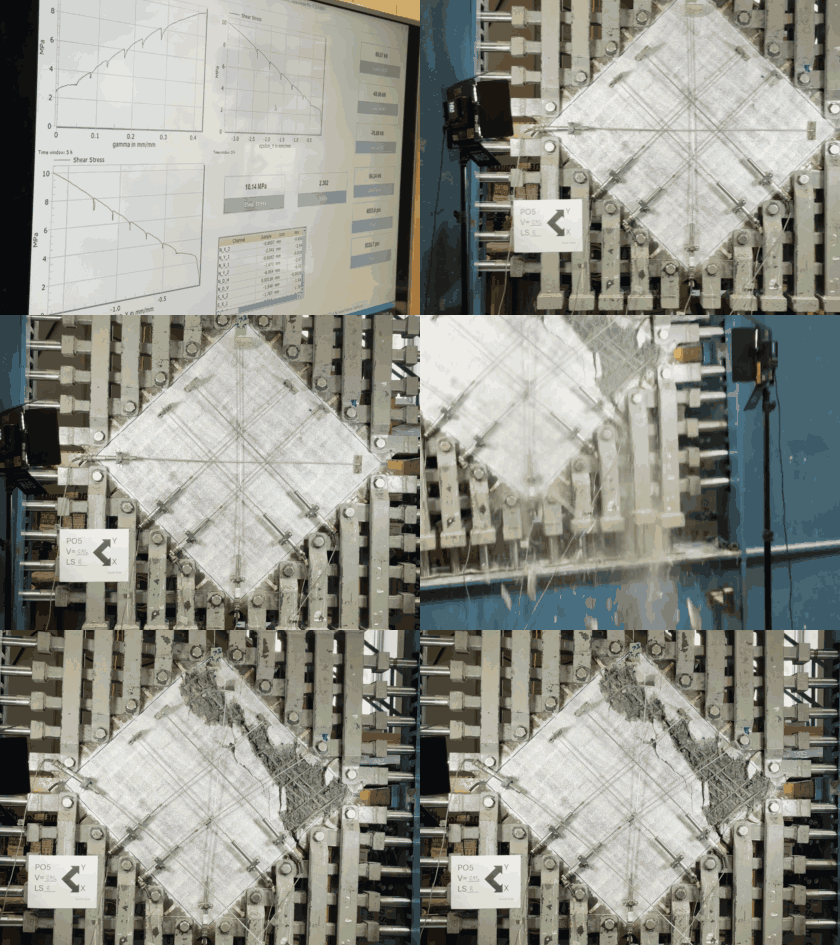
- Shear strength and failure load
- Shear stress-strain response
- Reinforcement strain
- Crack development
- Creep and sustained-load behaviour
LVDTs are arranged in the X, Y and diagonal directions to calculate longitudinal and shear strains, while Digital Image Correlation (DIC) provides an additional method for validating deformation measurements and observing surface behaviour.
05Results and engineering significance
The project evaluates whether lower-carbon concrete can be incorporated into structural design without compromising the reliability of established shear-design methods. Preliminary research indicated that approximately 50% slag replacement can still provide the desired structural properties and behaviour, while the remaining panel tests will further evaluate shear response across different reinforcement ratios.